

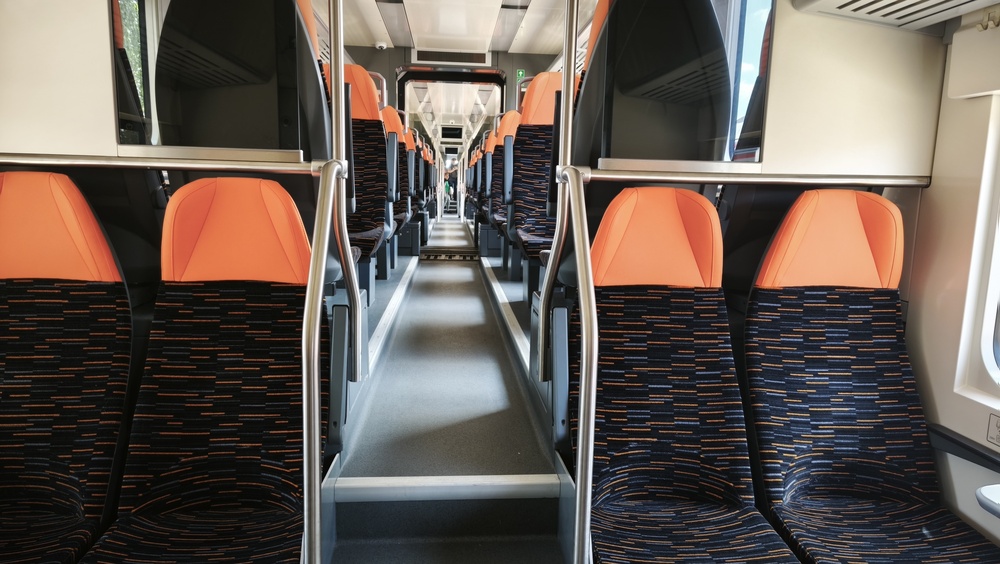
Rail car interiors have to do more than look modern. Passengers will notice how much noise reaches the cabin, how much vibration travels through the floor and panels, and how comfortable the space remains throughout the trip.
For rail OEMs, those expectations have to be balanced against weight, available space, and material requirements.
Refurbishers face a different challenge in improving performance inside an interior that has already been designed.
Advanced foam materials give both groups more flexibility to improve the passenger environment without adding unnecessary complexity.
In this article, we will cover:
- How interior materials influence passenger comfort
- Where noise and vibration can enter the cabin
- How lightweight insulation supports thermal and acoustic performance
- How damping and isolation materials can help control structural vibration
- What changes when an existing rail car is refurbished
Start with what passengers experience
Passengers may never see the insulation behind a wall panel or beneath a floor, but they experience its performance throughout the ride.
- Wheel and track interaction can introduce sound and vibration through the vehicle structure.
- Equipment systems, including HVAC fans and ductwork, can introduce mechanical and airflow noise into the passenger cabin.
- Exterior temperatures place additional demands on the interior.
That makes the material system behind the finished surfaces an important part of ride quality.
For engineers, the goal is to make those hidden layers perform better without adding unnecessary mass or taking up valuable space. The right solution depends on where the material is used and what energy needs to be managed.
Match the acoustic treatment to the location
A rail car does not have just one acoustic problem. Different parts of the interior are exposed to different noise paths.
Common treatment areas include:
- Floors: where sound can enter from the rail and undercarriage
- Walls: where cavities may transmit or reflect sound
- Ceilings: where lightweight absorptive materials can help manage interior noise
- Doors and partitions: where sound can pass between spaces
- HVAC systems and ducts: where fan, equipment, and airflow noise can travel through the system and enter occupied spaces
The material function matters as much as the location.
Absorptive foam (PMF or PHM) helps reduce sound energy within a cavity. Barrier materials (PAB) help limit transmission from one area to another. In applications that require both, acoustic barrier composites (PABA) can combine absorptive and barrier functions within a single construction.
Keep insulation light without giving up performance
Thermal insulation needs to help maintain a comfortable interior while staying within tight weight and space constraints. That makes melamine foam especially useful in walls, ceilings, and HVAC systems and ducts.
Within HVAC assemblies, insulation can help limit unwanted heat transfer while also supporting acoustic control around fans, air-handling equipment, and duct paths. Because these systems often run through space-limited areas above ceilings or behind interior panels, lightweight materials can help engineers address thermal and acoustic performance without adding unnecessary mass.
Two POLYDAMP® options can serve different needs:
- POLYDAMP® Melamine Foam (PMF): A lightweight material that can support both acoustic and thermal insulation.
- POLYDAMP® Hydrophobic Melamine Foam (PHM): Another option with added water resistance for areas where moisture exposure is a concern.
These foams can help OEMs support broader vehicle weight goals. For refurbishment programs, it can provide a way to replace aging material without adding unnecessary mass to the existing car.
Where the application calls for it, we can also incorporate facings to support handling, additional moisture resistance, or other surface requirements.
Control vibration through floors and panels
Rail vibration is not limited to what passengers hear.
Energy from wheel and track interaction can move through the vehicle structure and excite floors, wall panels, or other interior surfaces. Those surfaces may then contribute additional noise inside the cabin.
Rather than adding treatment everywhere, engineers should focus on the structural areas that are most responsive to vibration. Damping materials can help reduce panel response, while isolation materials can limit energy transfer at selected points. Acoustic foam can then address airborne sound within the surrounding interior space.
New-build and refurbishment projects start from different places
The performance goals may overlap, but the design process is different.
New rail OEMs
There is more freedom to plan the material system early. Wall cavities, flooring assemblies, and ceiling structures can be developed with the acoustic and thermal strategy already in mind.
That gives engineers greater control over where foam, barriers, or damping materials are placed before the interior design is finalized.
Refurbishers
- Panel dimensions may be fixed.
- Cavities may be shallow.
- Existing insulation may need to be removed and replaced without rebuilding the surrounding structure.
In those cases, the question becomes where can a material change deliver the greatest improvement without expanding the scope of the refurbishment?
Material selection can also account for how the insulation will be cut, handled, and installed within the existing interior. Where appropriate, options such as pressure-sensitive adhesive backings can help simplify installation.
That flexibility can make targeted upgrades more practical while keeping the refurbishment process in mind.
Make every interior upgrade count with Polymer
Whether a rail car is entering production or returning to service after refurbishment, interior materials can influence how comfortable and refined the vehicle feels in operation.
For a new platform, the opportunity is to integrate acoustic and thermal materials before the interior architecture is locked in. For an existing fleet, the focus may be narrower. Identify the areas where a material upgrade can improve performance without requiring a major redesign.
Polymer works with rail OEMs and refurbishers to select foam, barrier, and vibration-control materials around the needs of the application.
Planning a new rail interior or evaluating an upgrade? Talk to an Expert about the material options for your project.