

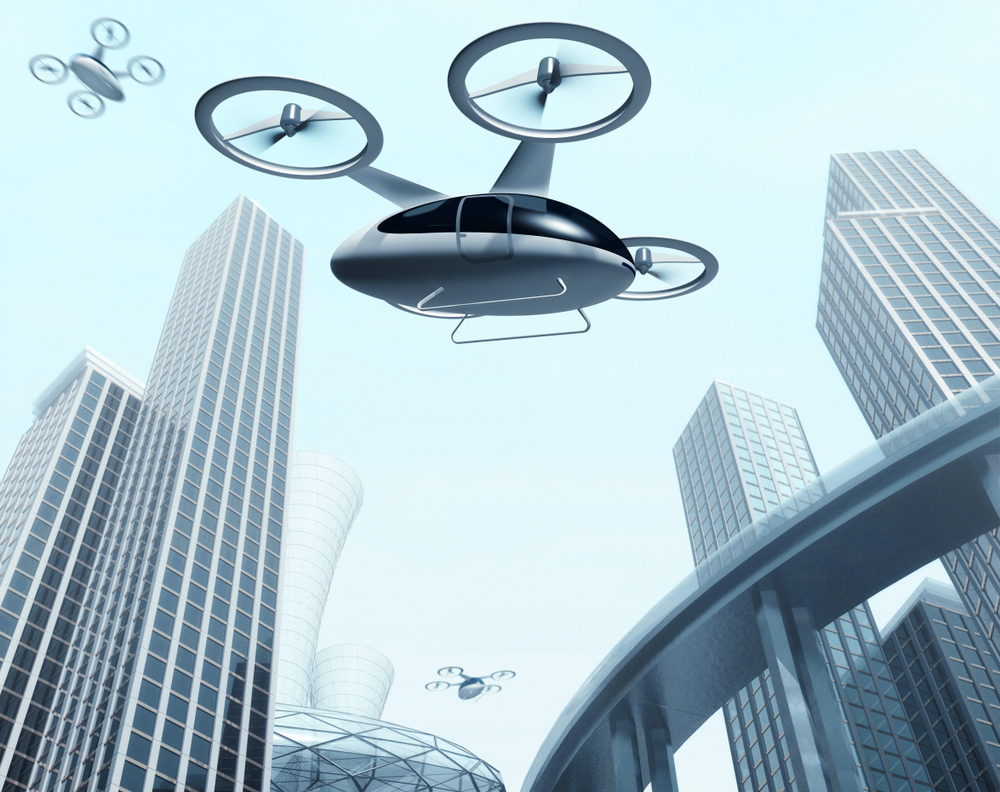

The promise of urban air mobility (UAM) extends well beyond drone deliveries and air cargo. Increasingly, it points toward a future where passengers can travel above congested streets in quiet, electric aircraft designed specifically for short urban routes.
At the center of this vision are electric vertical take-off and landing aircraft (eVTOLs), which are powered by electric propulsion systems that can take off, hover, and land vertically without the need for traditional runways. These vehicles are designed to move passengers quickly across dense urban environments while reducing noise and emissions.
Keeping the noise down is critical, particularly as riders will expect a quiet, premium travel experience. In this short guide to eVTOL aircraft, we will explore some of the causes for noise on these flights and the foam solutions that can help mitigate them. We will also briefly discuss energy loss and thermal challenges related to urban air mobility.
Topics explored include the following:
- The current status of eVTOL aircraft and the challenges that remain to bring them to market.
- What NASA has identified as potential gaps in noise challenges for urban air mobility.
- How Polymer’s melamine hydrophobic materials are flexible enough for a range of aircraft applications.
- Foam solutions for the fuselage, environmental control system, flooring, trim panels, and more to reduce noise, maintain passenger comfort, and improve energy efficiency.
Can you ride in an eVTOL right now?
Unfortunately, you’ll need another method to beat the traffic. For now, eVTOLs remain in the development stage. Major aerospace manufacturers and startups are testing prototypes and refining designs as they work to bring passenger-focused urban air mobility closer to market. And we’re only starting to build and plan out the infrastructure and regulatory systems to ensure performance and safety.
Acoustic management is also a work in progress. NASA’s Urban Air Mobility Noise Working Group (UNWG) has spent years identifying the gaps between current aerospace technology and the unique needs of eVTOL aircraft. Their research suggests that new methods and materials may be required to address four gaps in urban air mobility:
- Decibels don’t tell the whole story: Traditional dB measurements capture overall loudness but miss the tonal sharpness and high-frequency fluctuations common in electric motors.
- Noise travels through the structure: In compact eVTOL designs, vibrations from rotors and motors can travel through the aircraft frame itself, carrying noise directly into the cabin.
- Lightweight structures block less sound: Composite skins help reduce aircraft weight and improve efficiency, but they are less effective at blocking high-frequency sounds.
- Passengers react differently to new sounds: The tones produced by electric rotors during takeoff, landing, and maneuvering can be more noticeable and fatiguing for passengers.
To close these gaps identified by NASA, engineering teams must look beyond standard fiberglass insulation. We’ll now look at some of the ways our advanced foam materials can potentially help prevent noise transmission into the cabin for a quieter experience expected by passengers.
Foam solutions for eVTOLs that eliminate noise and vibration in the cabin
Working with aerospace and aircraft manufacturers, Polymer Technologies has helped address complex acoustic and vibration challenges. Our lightweight, fire-resistant open-cell foam insulation materials are AS9100D-certified and engineered to target the high-frequency noise and structural vibration issues associated with electric flight.
For eVTOLs, our POLYDAMP® Hydrophobic Melamine (PHM) foam materials solve noise and vibration challenges without the risk of moisture gain. PHM is ultra-lightweight, meets FAA and aerospace industry standards for fire protection, and offers excellent moisture resistance. We’ll examine how it can be applied in different areas of the aircraft to reduce sound and minimize energy loss.
Fuselage and Bulkhead Insulation
Lightweight composite skins are essential in eVTOL aircraft because they improve flight efficiency, but they are less effective at blocking high-frequency noise. Research from NASA identifies this as a key challenge for passenger acceptance, since sharp tonal whines from electric propulsion systems can easily penetrate the cabin.
PHM foam insulation helps address this issue. It can be compression-fit between frames and over stringers, creating a lightweight acoustic barrier within the aircraft structure. Because the material resists settling and maintains its thickness over time, it provides consistent sound absorption without adding significant weight even in humid conditions.
Insulation for Environmental Control Systems
With a near-silent cabin, the Environmental Control System (ECS) can become a primary source of distraction. High-speed air rushing through ducts creates a persistent high-frequency hiss right next to the passenger’s head. Simultaneously, these ducts are a major source of energy loss.
- By wrapping aircraft ducts in POLYDAMP® PHM foam, manufacturers can stop the air-rush noise at the source. The open-cell structure of the melamine foam is specifically designed to absorb the high-frequency sounds that traditional insulation might miss.
- Paired with POLYTECH® PEEK facings for extra durability, this wrap creates a high-performance thermal barrier. This prevents condensation and keeps conditioned air at its target temperature as it travels through the aircraft.
By sealing the ducting, the system reduces the workload on the electric HVAC. This preserves critical battery power, directly supporting the aircraft’s total flight range and operational efficiency.
Acoustical Flooring and Trim Panels
The proximity of the rotors to the passenger seating can create a unique structural challenge. The thin, lightweight interior trim panels and floorboards could begin to resonate. PHM can be combined with high-mass fabrics or specialized vibration isolators to be applied directly to the interior trim and flooring. This creates a decoupled barrier that stops structural vibration before it can be felt or heard by the passengers.
- The combination of melamine foam and high-mass barriers kills the ringing effect of composite panels, ensuring a solid, quiet interior feel.
- It significantly reduces the amount of structure-borne noise that is transmitted into the cabin during high-power flight phases.
- The hydrophobic nature of the foam is essential for flooring, where moisture is tracked in by passengers or cabin condensation.
Designing a quieter future for eVTOL cabins
As eVTOL aircraft remain in the prototype and development stage, there is still significant opportunity to improve cabin acoustics and overall passenger comfort. By addressing high-frequency tonal noise and structure-borne vibrations early in the design process, manufacturers can create quieter cabin environments that meet the expectations of future air taxi passengers and support the broader vision of urban air mobility.
At Polymer Technologies, our PHM foam insulation materials are engineered to help solve these challenges. Contact our team to discuss a customized solution that can improve noise and vibration reduction while also enhancing thermal efficiency.